- 定價127.00元
-
8
折優惠:HK$101.6

|
|
|
|
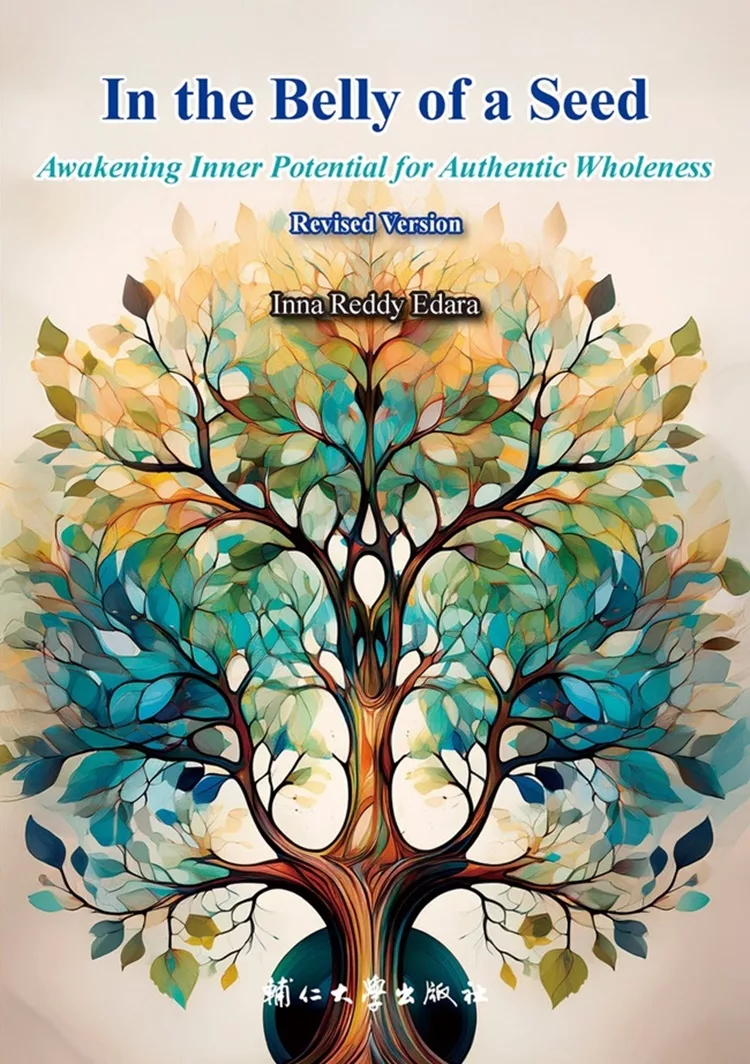
In the Belly of a Seed: Awakening Inner Potential for Authentic Wholeness (Revised Version)
|
|
沒有庫存
訂購需時10-14天
|
|
|
|

|
|
9789860729948 | |
|

|
|
林瑞德(Inna Reddy Edara) | |
|

|
|
輔仁大學出版社 | |
|

|
|
2026年2月01日
| |
|

|
|
150.00 元
| |
|

|
|
HK$ 127.5
|
|
|
|
|

| |
|
|
|
|
| |
|
|
詳
細
資
料
|
ISBN:9789860729948叢書系列:教育學習規格:平裝 / 404頁 / 14.8 x 21 x 2 cm / 普通級 / 單色印刷 / 初版出版地:台灣
教育學習
|
|
分
類
|
專業/教科書/政府出版品 > 政府出版品 > 教育學習 > 大學出版中心 |
同
類
書
推
薦
|
|
|
內
容
簡
介
|
In this book, I trace the winding paths of my life: the fragile beginnings of childhood, the shaping of character and personality, the search for health and wholeness, the awakening of faith, the long seasons of formation, the call to consecrated life and priesthood, and the outward journeys of mission and ministry. Alongside the joys, I speak also of the shadows—the doubts and struggles, the inner conflicts and external storms that tested my roots. I share how I learned to make peace with what I could not change, and to integrate what once felt broken into something whole. Woven through these stories are the theoretical voices of philosophy, psychology, anthropology, theology, missiology and spirituality—threads of wisdom that helped me make sense of my experience, and that my experience, in turn, has made more real and whole.
The narrative takes root in a landscape of critical reflection and scholarly inquiry, making the personal and the academic converse with each other—experience becoming text, and text breathing life back into experience, and it is in their meeting that true understanding deepens. My hope in writing this book is not only for personal growth but also it might invite the readers to pause, to turn inward, to listen for the seeds lying quiet within themselves, to recognize their intrinsic potential and to tend them gently until they sprout and bloom.
|
|
目
錄
|
Preface
Section I: Recognizing
In the Belly of a Seed
1.1 Seeds of Joy
1.2 Vocation: A Gift from God
1.3 In the Belly of a Seed
1.4 Authentic Wholeness
1.5 Inner Potential for Authentic Wholeness
1.6 The Structural Plan of the Book
Section II: Sowing
Family of Origin
2.1 Gift of Life
2.2 Family of Origin
2.3 Validating Roots and Wings
2.4 Indispensable Influence
2.5 Tracing My Place in the Family of Origin
2.6 Sowing Faith and Spirituality
Section III: Planting
Personality, Values, Virtues
3.1 Personality and Traits
3.1.1 My NEO PI-R Personality
3.1.2 My INFJ Personality Type
3.1.3 Enneagram and Personality
3.1.4 Integrating the Various Personality Test Results
3.2 Values and Behavioral Modes
3.2.1 Value of Punctuality
3.2.2 Caste System and Equality in India
3.2.3 Indigenous People’s Rights in Alishan (Taiwan)
3.2.4 International Students’ Rights in the USA
3.2.5 Gender Equality in Fu Jen Dormitories in Taiwan
3.2.6 Discrimination Against African/Black Students
3.3 Virtues and Character Strengths
3.4 Integrated Narrative
Section IV: Fertilizing
Well-Being and Spirituality
4.1 Health and Well-being
4.1.1 Holistic Health
4.1.2 Benefits of Well-Being
4.1.3 What Improves Well-Being?
4.2 Emotional Intelligence
4.3 Faith and Spirituality
4.3.1 Religion and Spirituality
4.3.2 Spiritual Worldviews and Practices
4.3.3 Religious and Spiritual Development
4.3.4 Personality and Spirituality
4.3.5 Spiritual Journeys
4.3.6 My MBTI Personality and Spiritual Journey
4.3.7 Enneagram and Spirituality
4.3.8 Summary: My Personality and Spiritual Journey
4.3.9 Finding Spiritual Growth by Finding Ourselves
4.3.10 Spirituality and Image of God
Section V: Grafting
Education and Formation
5.1 The Function of Education
5.2 Basic Education: Meeting the Basic Learning Needs
5.2.1 Primary School: Arousing Curiosit
5.2.2 High School: Carving the Path for Advanced Education
5.2.3 Intermediate: Though Ripened among Thorns, the Fruit is Sweet
5.3 Higher Education
5.3.1 Bachelors and Masters Degrees: Our Learning Follows Us
5.3.2 Ph.D. Studies: The More We Learn, the More We Want to Learn
5.4 Formation for Consecrated and Priestly Life
5.4.1 Minor Seminary: Blossoming Vocation
5.4.2 Life in Palda: Spiritual, Intercultural, and Intellectual Integration
5.4.3 Philosophy: The More We Ponder it, the More it Eludes Us
5.4.4 Novitiate: A Time to Discern the Call to Consecrated Life
5.4.5 Theology in Pune
5.4.6 OTP in Taiwan: Intercultural Experience and Missionary Formation
5.4.7 Acculturation and Interculturality
5.4.8 Stomach Upset due to Eating Beef Noodles
5.4.9 Learning Mandarin Chinese
5.4.10 Regency and Pastoral Exposure
5.4.11 Leave of Absence to Live Like a Lay Person
5.4.12 Theology at Fu Jen: Faith Seeking Understanding
5.4.13 Consecrated Life
5.4.14 Religious Vows
5.4.15 Diaconate and Priesthood
5.4.16 Glory of Priesthood, Ordinariness of Priests
5.4.17 Summary of Vocation Journey
Section VI: Reaping
Ministry and Mission
6.1 Jesus Mission is Our Mission
6.2 Mission Exposure and Immersion
6.3 A Train to Nowhere
6.4 Caring for a Bedridden Stranger
6.5 Contextualized Service in Nursing Home
6.6 Apostolate for People with HIV/AIDS
6.7 Undeterred Commitment Despite Unexpected Appointment
6.8 Becoming Those You Serve
6.9 Being Available to People
6.10 Accompanying the Seminarians
6.11 Counseling to Unlock Inner Potential
6.12 My Eclectic Approach to Counseling and Guidance
6.13 Teaching as a Calling to Specific Mission
6.14 Leadership is Ministry
6.15 Transformation-Oriented Servant Leadership
6.16 Conclusion: Cohesive Narrative of Ministry and Leadership
Section VII: Pruning
Challenges and Resilience
7.1 Seeds Among Thorns and Resilience
7.2 Cultivating Resilience to Care for Health and Well-Being
7.2.1 Ear Piercing as a Toddler
7.2.2 Restless Legs Syndrome
7.2.3 Obsessive-Compulsive Symptoms
7.2.4 Mugged in London
7.2.5 Is Being an Introvert a Sign of Weakness?
7.2.6 Lack of Musical Abilities
7.3 Building Resilience in Times of Racism and Discrimination
7.3.1 When Humor Hurts!
7.3.2 A Racist Professor
7.3.3 Taiwanese Stereotyping Indians and Africans
7.3.4 Mistook Me for a Migrant Worker
7.3.5 What Skin Color Has To Do With Teaching Effectiveness!
7.3.6 Someone’s Win is Not My Loss! And, Losing is Not a Disgrace!
7.3.7 Summary
7.4 Honing Resilience in Priesthood and Consecrated Life
7.4.1 Is Priesthood an Escape from Poverty?
7.4.2 Formation of Flawed People and Wounded Souls
7.4.3 Dismissed, Almost!
7.4.4 A Period of Transition Or, a Crisis?!
7.4.5 Challenges to Consecrated Life
7.4.6 The Catholic Priesthood in Crisis
7.4.7 Dangers of Priests Playing Favorites
7.4.8 Faithful Leaving the Church
7.4.9 Conclusion: Sustaining Witness to the Gospel in Modern Contexts
Section VIII: Sustaining
Organic Metamorphosis
8.1 Seeds of Organic Metamorphosis
8.2 Phenomenology of Life’s Metamorphosis
8.3 Intrinsic Potential for Metamorphosis
Section IX: Journey
Metamorphosis Toward an Authentic Wholeness
9.1 The Mystery of the Seed
9.2 The Seed’s Shell: Personality, Persona, and the Self
9.3 The Seed’s Roots: Values, Virtues, and Faith
9.4 The Seed’s Shoots: Growth and Flourishing
9.5 The Seed’s Fruits: Maturity, Generativity, Meaning, and Holiness
9.6 Authentic Wholeness in the Belly of a Seed
Section X: Gratitude
Seeds of Gratitude and Hope
10.1 Seeds of Gratitude
10.2 My Prayer of Gratitude
Bibliography
|
|
序
|
Socrates once said that “an unexamined life is not worth living.” His words, though ancient, still ring with a quiet urgency. Life slips by quickly if we do not stop to notice it. We rise and labor and strive, yet the days pass like shadows if we never turn inward. I have come to believe that the worth of a life lies not in its noise or its achievements, but in its depth—in the willingness to pause, to look within, and to wonder at the mystery of one’s own becoming. Reflection is not an escape from life; it is how life becomes fully ours.
Aristotle and Lao Tzu both taught that wisdom begins with knowing oneself. Over the years, I have discovered how easily we overlook this simple truth. Our days fill with duties and demands, and we move forward propelled by momentum more than intention. Yet whether we are aware of it or not, our life is quietly shaped from within—by the values we hold, the hopes that guide us, the questions we dare not speak, and the longings that linger behind everything. These inner currents shape the arc of our days and, slowly, the story of who we become.
St. Augustine once wrote that people wander the world to marvel at the peaks of mountains, the thunder of waves, the sweep of rivers, the vastness of oceans, the circling of stars—and yet they pass by themselves without wonder. His words have often returned to me like a gentle rebuke. For God, who fashioned us from within, does not see us as distant or disposable. God sees us as we truly are—fragile, luminous, unfinished—and longs for us to see ourselves that way too. To know oneself is not a selfish act; it is a way of drawing closer to God, and to others, and to the hidden wholeness within.
In February 2024, I stepped away from the rhythm of my work to begin a sabbatical year. I wanted, at last, to listen to my own life. After decades of moving from one responsibility to another, I felt called to pause, to gather the scattered pieces of my story and hold them to the light. When I shared this desire with my siblings, they encouraged me to write it all down. They reminded me that I had left home to join the seminary in 1984, and that since 1992 I had lived outside India—much of my life had unfolded far from the gaze of those who first knew me. Others too encouraged me, and so, tentatively, I began writing. What started as scattered notes slowly rooted and sprouted. The first version of this book grew from that small beginning. I have called it “In the Belly of a Seed: Inner Potential for Authentic Wholeness.”
The image of the seed has long spoken to me. My father’s saying “in the belly of a seed”—a simple phrase, yet it has the fullness of wisdom and carried the weight of a quiet revelation. A seed looks so small, so still, almost empty. And yet, hidden in its belly, there is a whole future waiting: roots and stems, blossoms and fruit, and the countless seeds that will follow. Life begins this way—in silence, in secrecy, in hope. I have come to see that each of us carries within us something similar: a deep and mysterious potential, planted long before we are aware of it, waiting for the right conditions to awaken, to stretch toward the light, and to bear fruit that will nourish others.
In the first version of the book, I trace the winding paths of my life: the fragile beginnings of childhood, the shaping of character and personality, the search for health and wholeness, the awakening of faith, the long seasons of formation, the call to consecrated life and priesthood, and the outward journeys of mission and ministry. Alongside the joys, I speak also of the shadows—the doubts and struggles, the inner conflicts and external storms that tested my roots. I share how, slowly and often haltingly, I learned to make peace with what I could not change, and to integrate what once felt broken into something whole. Woven through these stories are the voices of philosophy, psychology, anthropology, theology, missiology and spirituality—threads of wisdom that helped me make sense of my experience, and that my experience, in turn, has made more real.
As the first version emerged in the tone of memoir—personal, intimate, and reflective—I also began to sense the call for a revised version: one that would hold these same life-stories yet frame them within the architecture of academic inquiry. Emerging from the same soil as the first, this revised version, titled “In the Belly of a Seed: Awakening Inner Potential for Authentic Wholeness,” carries within it the same seeds of story—moments of wonder and struggle, seasons of silence and awakening, the gradual unfurling of vocation, and the ongoing search for wholeness. Yet here, the narrative takes root in a different landscape of critical reflection and scholarly inquiry.
This revised version seeks to deepen the conversation between experience and theory, to let my personal journey be read not only as narrative but also as text, as a living case through which philosophical, psychological, anthropological, theological, missiological and spiritual principles may be explored and embodied. While the first version speaks in the intimate voice of memoir, this version seeks to let the personal and the academic converse with each other—experience becoming text, and text breathing life back into experience. I have long believed that lived reality and theoretical knowledge are not opposites, but companions. What theory offers in clarity, experience anchors in flesh and time; what experience holds in its mystery, theory helps us to name. It is in their meeting that true understanding deepens.
The purpose is not to reduce experience to theory, nor to decorate theory with anecdotes, but to allow each to illuminate the other, revealing the dynamic process through which the human person is formed, re-formed, and continually called toward authentic wholeness. My hope is that this dual movement—of experience flowing into theory and theory returning to illuminate experience—will offer a more textured and rigorous account of what it means to grow toward authentic wholeness.
But more than anything, this is a book about becoming and transformation. It is not, I hope, merely the story of my life, but a mirror in which you may glimpse your own. My hope is that these words might invite you to pause, to turn inward, to listen for the seeds lying quiet within you, to recognize their intrinsic potential and to tend them gently until they sprout and bloom.
As I write this book, gratitude floods my mind and heart. I thank God for blessing me with a life both tender and fierce, for giving me strength when I faltered and grace when I could not go on. As St. Paul once wrote, “when I am weak, then I am strong” (2 Corinthians 12:10). I thank my family and friends who carried me with their encouragement, especially when I doubted this work and nearly laid it aside. Their faith rekindled my own. And finally, I thank every soul who has touched my life—including you, the reader—for shaping who I have become, and for walking with me, in spirit, into the chapters still to come.
Father Inna Reddy Edara, SVD, Ph.D.
February 2026
|
|
|
書
評
|
|
|
|
|